Leave Your Message

Why is N Hydroxysuccinimidyl Important in Biochemical Research?

N Hydroxysuccinimidyl plays a crucial role in biochemical research. Its significance lies in its ability to form stable conjugates with proteins and other biomolecules. This bioconjugation tool is especially valuable in developing targeted therapies and diagnostic agents.

Researchers use N Hydroxysuccinimidyl derivatives to enhance the efficiency of various procedures. This includes reactions that modify antibodies or other proteins. Effective labeling and drug delivery systems often rely on this compound. However, challenges remain in ensuring specificity and minimizing side reactions during these processes.

Understanding N Hydroxysuccinimidyl's properties is essential for advancing scientific techniques. Researchers must navigate the complexities of bioconjugation chemistry. Striving for improved outcomes, scientists face design and implementation hurdles. Each step requires critical evaluation to achieve desired results in their work.

Why is N Hydroxysuccinimidyl Important in Biochemical Research?

The Role of N Hydroxysuccinimidyl in Biochemical Research

Why is N Hydroxysuccinimidyl Important in Biochemical Research?

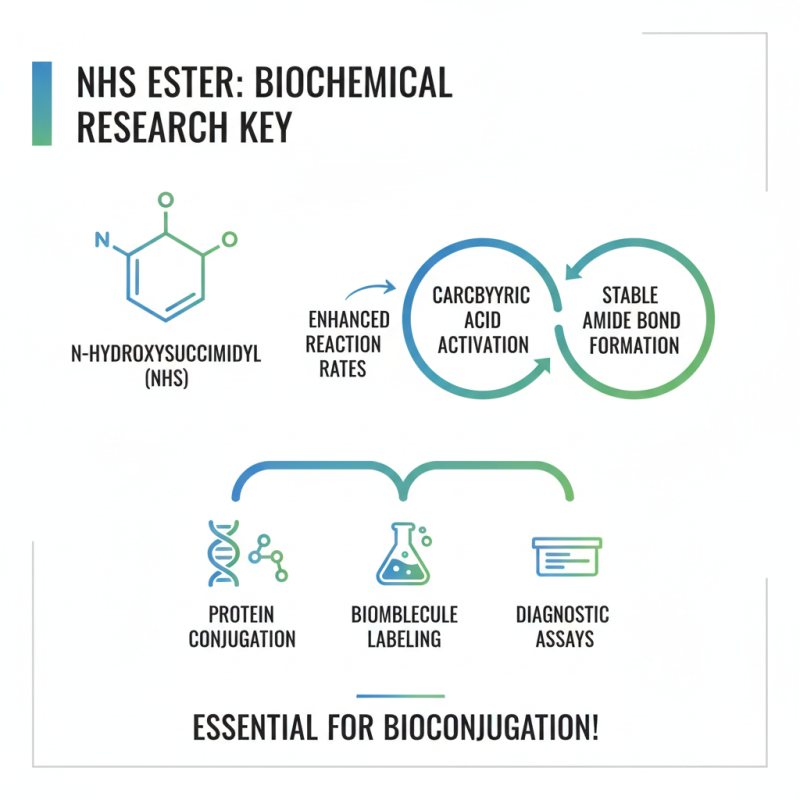
N Hydroxysuccinimidyl, often abbreviated as NHS, plays a critical role in biochemical research. It facilitates the formation of stable amide bonds. This property is essential for conjugating proteins with other biomolecules. The efficiency of the NHS ester in activating carboxylic acids is remarkable. Researchers appreciate its ability to enhance reaction rates, making it indispensable in various applications.

In protein labeling, NHS esters react with amino groups in proteins. This method helps attach fluorescent tags or labels. Such modifications are key for studies in cell biology and protein interactions. However, caution is needed. NHS esters can react with unintended amines, leading to byproducts. These side reactions pose challenges in experimental design. Researchers must carefully control their conditions.

The impact of NHS in creating stable bioconjugates cannot be overstated. It allows for precise studies on cellular processes. Yet, it also requires an understanding of potential pitfalls. As scientists push the boundaries, the need for improvements becomes clear. New techniques and protocols are necessary to minimize errors in NHS-based reactions.


Mechanism of N Hydroxysuccinimidyl in Protein Labeling

N Hydroxysuccinimidyl (NHS) plays a crucial role in biochemical research. It serves as a vital reagent for protein labeling. The mechanism involves the reaction of NHS with amine groups present in proteins. This reaction forms stable amide bonds. Thus, it enables the conjugation of various probes, such as fluorescent tags or enzymes. Researchers use this method to track proteins within cells.

However, the reaction conditions can be finicky. pH and temperature need to be controlled. Too high or too low can lead to incomplete labeling. It's also important to consider the concentration of NHS. If too much is used, it can cause unwanted side reactions. This complicates results and leads to confusion.

**Tip:** Always perform a small-scale trial before your main experiment. This helps gauge the reactivity of your specific protein. Be cautious with your reagents; some may degrade over time.

Labeling proteins is not always perfect. Optimization may require multiple attempts. The process can lead to artifacts that aren’t representative of normal function. Keep records of each trial for future reference. By doing this, you can refine your approach and improve labeling efficiency over time.

Why is N Hydroxysuccinimidyl Important in Biochemical Research? - Mechanism of N Hydroxysuccinimidyl in Protein Labeling

Property Description Applications
Chemical Structure N-Hydroxysuccinimidyl (NHS) is a reactive ester derived from succinic acid. Used in the linking of proteins and other biomolecules.
Reactivity Highly reactive to amine groups, forming stable amide bonds. Ideal for protein labeling and conjugation.
Stability Stable under physiological conditions until reacted. Used in various biochemical assays and experiments.
Advantages Enhances detection sensitivity and signal amplification. Applicable in ELISA and Western blotting techniques.
Limitations May react with unintended amine sites leading to side reactions. Careful optimization of reaction conditions required.

Applications of N Hydroxysuccinimidyl in Drug Development

Why is N Hydroxysuccinimidyl Important in Biochemical Research?

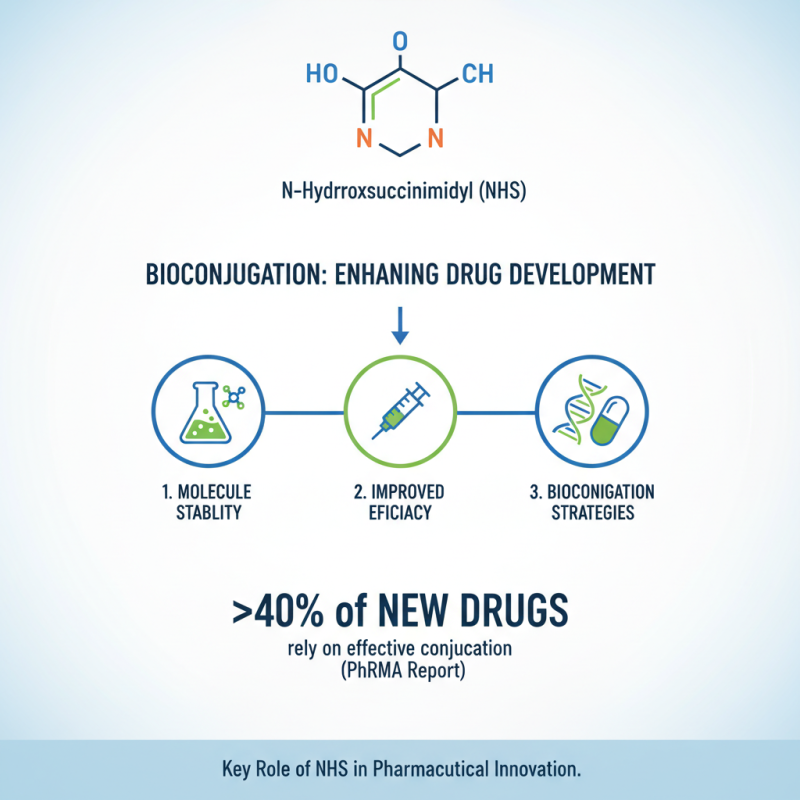
N Hydroxysuccinimidyl (NHS) plays a crucial role in drug development, especially in bioconjugation. This compound enhances the stability of drug molecules and improves their efficacy. In a report by the Pharmaceutical Research and Manufacturers of America, over 40% of new drugs rely on effective conjugation strategies to achieve desired therapeutic effects.

In recent years, NHS esters have gained traction. They enable the attachment of drugs to proteins or antibodies, enhancing their half-life and effectiveness in delivering treatments precisely. A study found that using NHS in conjugation can increase the stability of bioactive compounds by up to 60%. However, researchers face challenges in controlling the conjugation process. Using NHS can sometimes lead to heterogeneity in the final product. Such inconsistencies can complicate the development of therapies.

Researchers are also exploring the use of NHS in targeted drug delivery systems. By linking drugs to targeting moieties, NHS can significantly improve selective binding to cells. This application is key for cancer therapies where precision is critical. The potential for improvement is evident, yet there remains a need for better optimization in conjugation protocols. Continuous advancements are necessary to maximize the usefulness of N Hydroxysuccinimidyl in drug development.

Advantages of Using N Hydroxysuccinimidyl Over Other Reagents

N Hydroxysuccinimidyl, or NHS, plays a crucial role in biochemical research. This reagent excels in protein labeling and conjugation. It reacts with amines efficiently, promoting stable linkages. This efficiency makes it popular among researchers. The resulting conjugates remain intact under various conditions.

NHS presents several advantages over alternative compounds. Its reaction is fast, often requiring just minutes. Other reagents might take hours to react fully. Moreover, NHS provides a strong covalent bond that resists hydrolysis. This stability is beneficial for long-term studies. Researchers value this reliability in experimental setups.

Despite these benefits, there are challenges. For example, NHS can be sensitive to pH changes. In some conditions, it may lead to byproduct formation. It’s essential for researchers to optimize their protocols. Careful consideration can help mitigate these issues. The advantages of using NHS often outweigh these drawbacks.

Future Directions for N Hydroxysuccinimidyl in Biochemistry

N Hydroxysuccinimidyl (NHS) plays a pivotal role in biochemistry. Its use as a crosslinker is becoming increasingly vital. Researchers are exploring new applications for NHS in drug development and diagnostic tools. Recent studies indicate that bioconjugation using NHS can enhance the efficacy of therapeutic agents. It’s a bridge connecting biomolecules, improving their interactions and functions.

Future directions for NHS in biochemistry look promising. The global bioconjugation market is projected to reach $6.93 billion by 2025, with NHS crosslinkers leading the way. Scientists are now investigating its potential in targeted drug delivery. However, challenges remain in optimizing NHS for specific applications. Some studies suggest variability in reaction conditions may lead to inconsistent results. This raises questions about reproducibility.

Moreover, as new probes and techniques emerge, researchers must adapt NHS chemistry. Innovations could open doors for NHS applications in personalized medicine. Frustration occurs when bioconjugation does not yield the expected outcomes. Addressing these shortcomings is essential for the progress of NHS technology in biochemistry. Each experiment teaches valuable lessons and inspires new approaches.

Importance of N Hydroxysuccinimidyl in Biochemical Research

This chart illustrates the significance of N Hydroxysuccinimidyl (NHS) in various biochemical applications, highlighting its versatility across different research areas.